Originally published in The Gold Standard Now blog on
Phra Phuttha Maha Suwan Patimakon
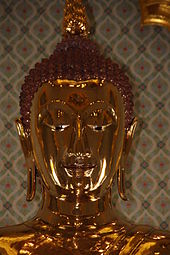
The largest gold statue in the world is said to be that of The Golden Buddha, officially titled Phra Phuttha Maha Suwan Patimakon.
This statue was plastered over, thought to be in anticipation of a Burmese invasion in 1767. It lay among the ruins of Ayutthaya until ordered collected, along with other Buddha statues, by King Rama I, of Thailand, in 1801, establishing Bangkok as Thailand’s new capital.
The statue’s golden substance went further undiscovered until it was moved, from a modest pagoda, in 1954. In the course of the move it fell, and some of the external plaster cracked off. As noted in Wikipedia, “The time when the gold statue was revealed was very close to the commemoration of the twenty-fifth Buddhist Era (2500 years since Gautama Buddha’s passing). The Thai news media at the time was full of reports about this event, and many Buddhists regarded such an occurrence as miraculous.”
The statue is almost ten feet tall and weighs over 5 long tons. At $1400 an ounce, slightly higher than currently, the gold content, running between 40% and 99% fine, is estimated to be worth around $250 million.
When critics of the classical gold standard, just as former Fed Chairman Ben Bernanke, protest that “there’s an awful big waste of resources. I mean, what you have to do to have a gold standard is you have to go to South Africa or some place and dig up tons of gold and move it to New York and put it in the basement of the Federal Reserve Bank in New York, and, that’s a lot of effort and work” — that’s as nothing compared to the history of the Golden Buddha. Nor a valid criticism of the classical gold standard.
Ralph Benko is an internationally award-winning, critically acclaimed writer, publishing in Forbes, Fortune, USA Today, Christian Science Monitor, Huffington Post, HackerNoon, Newsmax, Transpartisan Review, and other publications. He has authored hundreds of thousand of words in professional essays and columns focused on economic policy and politics and in 2022 was recognized as HackerNoon‘s contributor of the year for economics, politics, science, philosophy, art and scaling. Benko served as senior counselor to Buzz Aldrin for a decade during and after Dr. Aldrin’s tenure on the National Space Council. He has worked in or with three White Houses, two executive branch agencies, two Congresses, and many policy and advocacy institutes, including many years as editor and lead blogger for the Lehrman Institute’s monetary policy website, thegoldstandardnow.org. He recently served as the editor of the critically acclaimed 500th anniversary edition of Nicolaus Copernicus’s essay On the Minting of Money, and previously served as lead author of the critically acclaimed The Capitalist Manifesto and coauthored Redefining the Future of the Economy: Governance Blocks and Economic Architecture. His first book, The Websters’ Dictionary: How to Use the Web to Transform the World, won the most prestigious international award for Web advocacy from the World eDemocracy Society in Paris. He is a member of the bar of the State of New York and is active as an emerging technology entrepreneur.
Copyright Notice: The Lehrman Institute wordmark, its logo, and blog name are the intellectual property of The Lehrman Institute and are used here with permission.